
Books come alive when they reach the hands of readers. In this section, we highlight genuine reader feedback—thoughts, impressions, and reactions from audiences who have experienced our authors’ work.
These reviews reflect how stories resonate beyond publication: what readers loved, what moved them, and why certain books stayed with them long after the final page. From emotional connections to compelling storytelling and memorable characters, reader insights offer a powerful look at how each book is received in the real world.
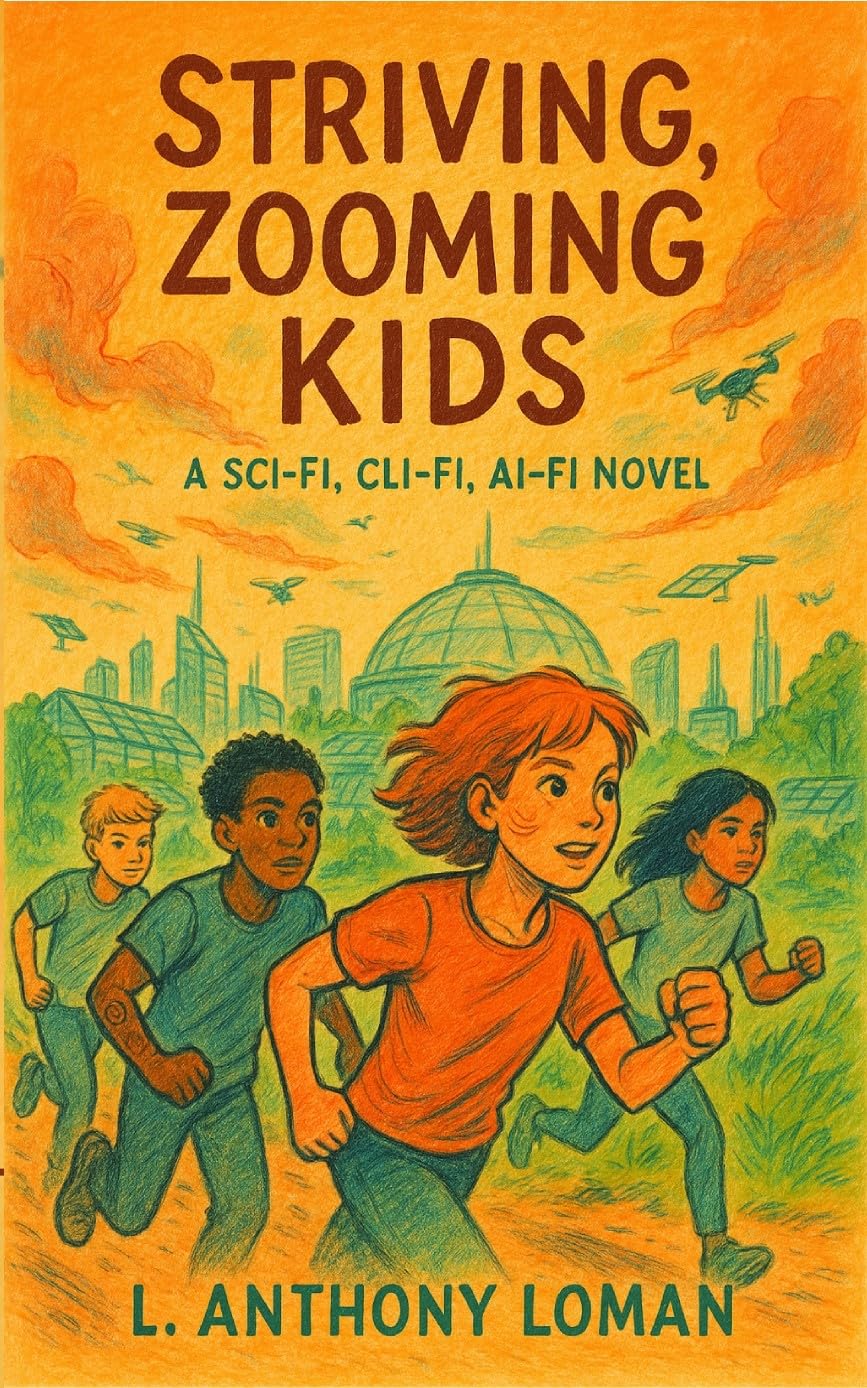
Striving, Zooming Kids by L. Anthony Loman completely abandons organic world-building, instead plunging readers into a heavy-handed landscape ravaged by extreme climate change and draconian immigration policies. Rather than introducing the dystopian setting naturally, the narrative forces the audience to navigate an overwhelming maze of exposition-heavy dialogue, as characters continuously halt the plot to explain the collapse of the West Antarctic Ice Sheet, the mechanics of internal nanobots, or the sociopolitical history of the U.S. government. The central conflict emerges from the tension between brothers Joe and Billy fleeing the overbearing government agency ISEA and their quest to reach the subterranean Meramec Union. However, it establishes a stark, highly politicized environment that is purposefully devoid of subtlety, replacing natural exposition with extended, unprompted lectures from adult characters like Sam Owens and Jayla Simmons.
Critically, the book operates more like a utopian manifesto than a crafted literary endeavor. The prose relies exclusively on the “internal AI” concept—featuring companions like VC, Arnie, and Penny—to conveniently resolve every narrative obstacle. Consequently, traditional tension is practically nonexistent; escalating threats from street gangs or military “autoweaps” are instantly neutralized by young children effortlessly hacking systems or firing tranquilizing “flea guns”. Genuine character development is largely absent, leaving the cast to function as one-dimensional ideological pointers rather than believable figures with emotional arcs. By leaning too heavily on the gimmick of technological convenience, such as the linked youth collective “Aada,” the text sacrifices narrative stakes and emotional depth, resulting in a mechanically hollow reading experience.
An exposition-heavy, mechanically hollow sci-fi adventure that will baffle general audiences while offering niche appeal to die-hard techno-utopians.
Striving Zooming Kids offers a compelling exploration of human resilience amidst a climate-ravaged landscape, utilizing the harrowing journey of two brothers, Joe and Billy, as its primary narrative engine. The plot’s progression from their escape from government forces to their integration into a subterranean cooperative underscores a potent theme: the necessity of communal interdependence over isolated survivalism. The novel’s true innovation lies in its conceptualization of internal, symbiotic AI, which allows the characters to forge an unprecedented collective consciousness that challenges traditional boundaries of selfhood. While the speculative science is rigorously structured, the emotional core remains deeply relatable, anchored by the poignant vulnerability and growth of its young protagonists as they navigate both environmental and technological frontiers.
— Aris Thorne
In the crowded field of dystopian fiction, Striving Zooming Kids decisively pushes the boundaries of the genre by introducing the concept of integrated, self-replicating internal AI networks. The narrative confronts massive, systemic issues—catastrophic climate migration and the ethical limits of artificial intelligence—through the focused lens of young refugees navigating a fractured America. By contrasting the oppressive, overarching government AI with the organic, cooperative intelligence developed by the children, the text sparks crucial conversations about the trajectory of human enhancement and community structure. It is a bold, thematic triumph that redefines the intersection of climate fiction and cybernetics.
— Margaret Vance
Buckle up, because Striving Zooming Kids is an absolute wild ride from the very first page! The plot rockets forward as brothers Joe and Billy dodge rogue police, outsmart menacing street gangs, and hijack autonomous vehicles, all while fleeing an overbearing government agency. It’s a wacky but brilliant twist that these kids have microscopic AIs living inside them, helping them hack vans and knock out bad guys with ring-mounted “flea guns”. The pacing never lets up, brilliantly balancing the high-octane action with genuine insights into what it takes to build a real community when the world is literally melting down around you.
— Jaxson Reilly
Talk about shaking things up! I just finished Striving Zooming Kids, and it totally gets all up in your feelings. You’re following these two bros, Joe and Billy, basically running for their lives across a ruined country, but the wildest part is they have these AI voices in their heads helping them survive. The juicy chats they have with their internal AIs—and eventually a whole squad of kids telepathically connecting—are so cool. It genuinely felt like hanging out with friends who just happen to be hacking government robots and dealing with massive climate drama. You’ve gotta read it; the vibes are immaculate.
— Chloe Martinez
Boom! Striving Zooming Kids will completely mess with your head! How can a story be this intense?! One minute Joe and Billy are running from the feds, the next they are rescuing orphans from collapsing caves, and then their internal AIs are magically spreading to their friends and a giant Mastiff dog! It constantly pokes at these massive, terrifying ideas—like, what happens when the oceans rise, and governments let machines take over? But the heart of it all is how fiercely these kids protect each other against unbeatable odds. It’s a breathtaking, emotional rollercoaster that made me cry, cheer, and question humanity’s future!
— Toby Carmichael
Bob Miles and his wife Janet reside in Southeast Pennsylvania.They are the parents of two Chinese-American children. Bob has worked as a professional guitarist and is the creator/host of Miles of Music (formerly, World of Guitar) television series. Miles of Music has aired on television for close to 25 years and in many markets including Nashville, Tennessee and Los Angeles, California. Bob has been honored twice by the New York Coalition for Healthy School Food and Once by The Pearl S. Buck Foundation. Bob also holds two Grammy certificates.


Let us talk about your publishing plans consultation is FREE!
You have held on to your story for so long or perhaps you have just started to think about writing–wherever you might be in your publishing journey, we can walk with you.
It’s time to embrace your destiny and transform your thoughts and ideas into a book. The path may be unfamiliar; for some, it can be scary. But anything of great value is worth your while–and ours. And we at EXPRESSO Publishing are ready to help you buckle up.
There is so much to do: laying out of your work, getting it copyedited, choosing a cover that will capture your vision and anything else that you can think of. Or even those that you have not thought of yet. We can help.
Fill out the form on this page and talk to our publishing consultants. Let us chart your book publishing journey today.
Got a book that you want to publish? Or are you interested in promoting a book you published elsewhere?
Do you need directions on how to get started? Do you want to talk to a publishing consultant here at EXPRESSO?
Fill out the form on thispage and allow us to help you today.
The juxtaposition of celestial perfection and terrestrial corruption in Xiong’s narrative offers a compelling study of dualism. The text operates less as a traditional fantasy adventure and more as a sociopolitical allegory, particularly in its exploration of “greed” as a contagion that disrupts the balance of “All Things.” While the heavenly sequences provide a theological framework, the narrative truly resonates in the second half, where the protagonist attempts to construct a sustainable governance model among the Ureullenz. The transition from mythic hero to pragmatic statesman is a fascinating
evolution, grounding the folklore in tangible human struggles. Ultimately, the work serves as a profound meditation on the resilience of cultural identity against the encroaching shadow of historical trauma.
— James Harris
Greed Effects Part 2 is not content to simply entertain; it aims to provoke a conversation about the trajectory of human civilization. The book pushes the boundaries of the genre by blending high-fantasy tropes with a stark warning about resource depletion and the “catastrophic self-reset” of society. It challenges the reader to look beyond the immediate battle between armies and consider the metaphysical war waged within the human conscience. Xiong successfully argues that leadership is not about power, but about the containment of malice—a timely theme for contemporary readers. It is a rare sequel that manages to expand its world-building while simultaneously sharpening its focus on the ethical responsibilities of those in power.
— Joseph Clark
Talk about a shift in gears! One minute we are floating through cloud tunnels in Heaven with a Prince, and the next we are dealing with hostage situations and burning villages on Earth. Touzeej’s journey is a wild ride that doesn’t shy away from the weirdness of its world—ducks that are actually servants? Check. A goddess becoming human? Double check. It’s wacky in the best way, but when the war drums start beating against the King of Strummulfizz, the stakes feel incredibly real. It’s a unique mix of dreamlike wonder and hard-hitting action.
— Sarah Wright